Performance
Why website speed decides whether you get the client
A slow website loses visitors before they ever see your offer. Here is why speed matters for sales and SEO, and where to start improving it.
Most business owners judge a website by how it looks. Visitors judge it by something else first: how long they have to wait. If a page takes more than a few seconds to appear, a large share of people never see the design, the offer or the contact form. They are already back on Google, clicking on a competitor.
That is what makes speed so easy to underestimate. A slow website does not throw an error and nobody calls to complain. Visitors simply leave, and the loss never shows up anywhere except in fewer enquiries and lower sales. In this article we explain why loading time matters so much, how Google measures it, where most websites lose precious seconds and what you can do about it, starting this week.
Speed is the first impression
Before anyone reads your headline, the browser has to download, process and display the page. That waiting time is the very first experience a visitor has with your brand, and people are far less patient than we like to think.
Google's research on mobile browsing found that as page load time goes from one second to three seconds, the probability of a visitor bouncing increases by 32%. From one to five seconds, it increases by 90%. On a phone, with a weaker signal and a smaller screen, every delay feels even longer.
Speed also shapes how trustworthy a business feels. A site that responds instantly comes across as modern, well run and reliable. A site that stutters, jumps around and makes people wait feels outdated, even if the design is beautiful. Visitors rarely think about it consciously, but they act on it.
What a slow website costs in real money
The link between speed and revenue has been measured many times. In the study Milliseconds Make Millions, Deloitte and Google analysed mobile websites of dozens of brands and found that improving load time by just 0.1 seconds increased conversion rates by 8.4% for retail sites and by 10.1% for travel sites. Visitors also viewed more pages and spent more per order.
Think about what that means for your business. If your website brings you ten enquiries a month, a faster site that converts even 10–20% better is one or two extra clients every month, without spending a single extra dinar or euro on advertising. If you already pay for Google or Meta ads, a slow landing page means you are paying for clicks from people who leave before the page even loads.
Google rewards fast websites
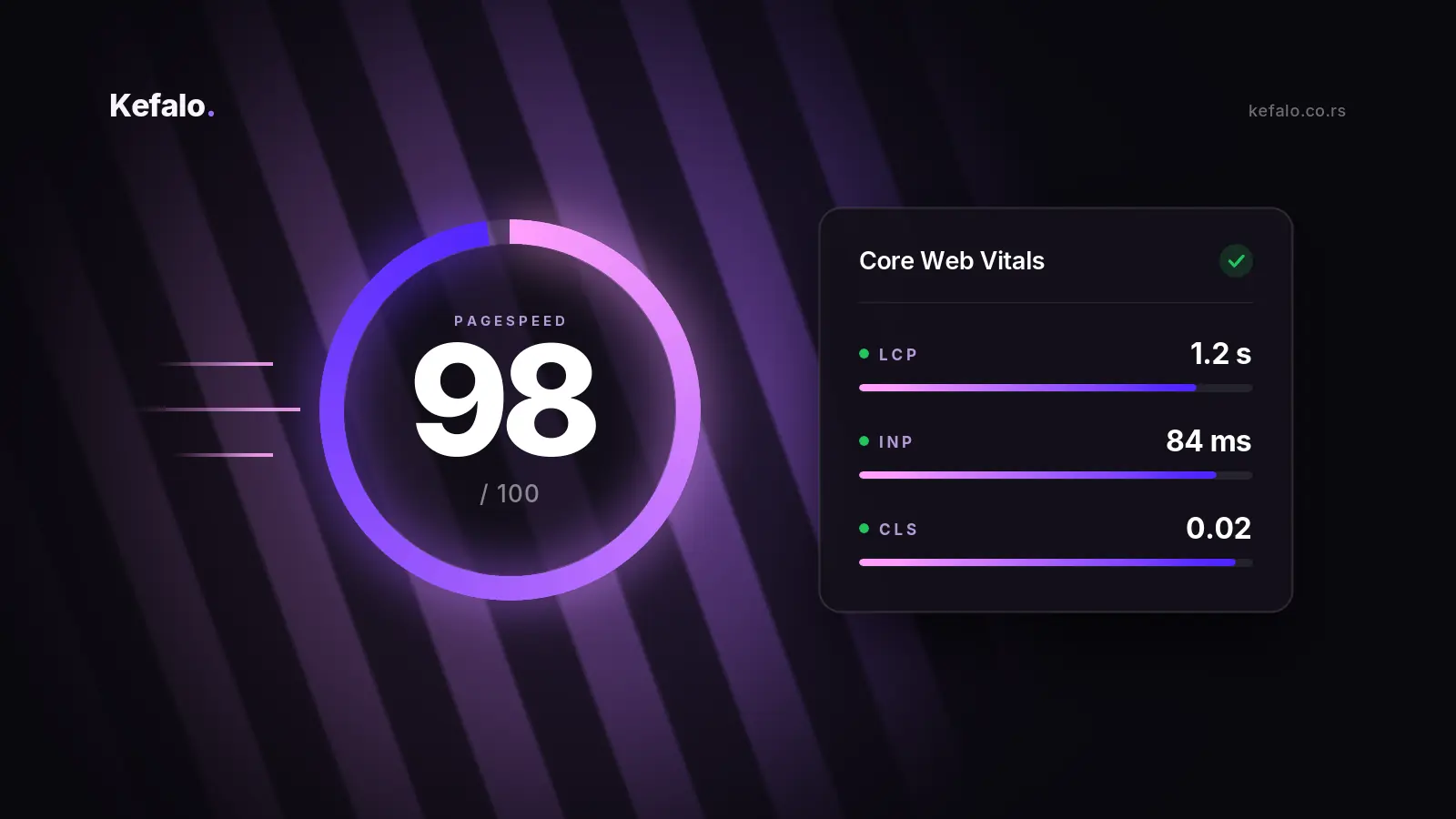
Page experience is part of how Google ranks search results. To make it measurable, Google introduced Core Web Vitals, three metrics that describe how a page feels to a real visitor:
- LCP (Largest Contentful Paint) – how quickly the main content appears, usually the large hero image or headline. Good: under 2.5 seconds.
- INP (Interaction to Next Paint) – how quickly the page reacts when someone taps, clicks or types. Good: under 200 milliseconds. INP replaced the older FID metric in March 2024 and is much stricter, because it looks at every interaction, not just the first one.
- CLS (Cumulative Layout Shift) – whether elements jump around while the page loads, for example when a button moves just as you try to tap it. Good: under 0.1.
Speed alone will not put a weak page at the top of Google, because content and relevance still come first. But when two websites offer similarly good content, the faster one has the advantage. In competitive local markets, that is often the difference between the first page and the second.
How to measure your website properly
The easiest place to start is PageSpeed Insights. Enter your address and you will get two kinds of results:
- Field data from real Chrome users who visited your site over the last 28 days. This is what Google actually uses, so it matters most.
- Lab data from a simulated test on a mid-range phone. It is useful for finding the exact causes of slowness, but the score can vary from test to test.
If your website is connected to Google Search Console, open the Core Web Vitals report there as well. It groups all your pages into good, needs improvement and poor, so you can see whether the problem is one page or the whole site.
One practical tip: always look at the mobile results first. Most websites look fine on a fast office computer and struggle on an average phone with a 4G connection, which is exactly how most of your visitors see them.
Where slow websites lose time
In the websites we audit, the same problems come up again and again:
- Huge, uncompressed images. A photo straight from a camera or stock site can easily be 3–5 MB. Shown at a width of 800 pixels, it could weigh less than 150 KB without any visible difference.
- Too many plugins and third-party scripts. Chat widgets, sliders, pop-ups, tracking pixels, social feeds and cookie banners each load their own files. Individually they look harmless, but together they can add several seconds.
- Slow hosting and no caching. If the server needs a second or more just to start sending the page, everything else starts late. Cheap shared hosting, outdated PHP versions and missing caching are the usual suspects.
- Render-blocking fonts, CSS and JavaScript. The browser often has to download and process these files before it can show anything at all, so the visitor stares at a white screen.
- Heavy page builders and themes. Multipurpose themes load code for hundreds of features you never use, on every single page.
- Layout shifts. Images without defined dimensions, late-loading banners and fonts that swap at the last moment make the page jump, which hurts both CLS and the user's patience.
Quick wins you can start with
You do not always need a new website. These steps often cut loading time in half:
- Convert images to WebP or AVIF and serve them in the size they are actually displayed.
- Use lazy loading for images further down the page, but never for the main image at the top.
- Always set width and height for images and videos to prevent layout shifts.
- Enable caching and compression (Gzip or Brotli) on the server, and consider a CDN if your visitors come from several countries.
- Remove plugins and scripts you no longer use, and load the rest only on the pages that need them.
- Defer non-essential JavaScript so it does not block the first view of the page.
- Limit web fonts to the weights you really use and load them with
font-display: swap. - Update to a recent PHP version and choose hosting that is built for performance.
When it is time for a rebuild
Quick fixes have limits. If your site is built on a heavy theme with dozens of plugins, every improvement becomes a fight against the foundation. Signs that a rebuild makes more sense than patching: mobile scores stay below 50 despite optimisation, every update breaks something, and simple changes take hours.
A website built with performance in mind from day one, with lean code, optimised images and only the features you need, is not only faster. It is also easier to maintain, more secure and cheaper to grow over the following years.
How we approach speed at Kefalo
For us, speed is not a final polish but part of the design and development process from the first sketch. When we work on an existing site, we follow four simple steps:
- Audit – we measure real field data and lab tests and find out exactly what is slowing the site down.
- Priorities – we rank fixes by impact, so the changes that bring the most results come first.
- Implementation – we optimise images, code, fonts, hosting and caching without changing what already works well.
- Monitoring – we track Core Web Vitals afterwards, because new content and features can slow a site down again over time.
A fast website is not a technical detail. It is the first part of your sales process.
Conclusion
Every second your website makes visitors wait costs you attention, trust and, in the end, clients. The good news is that speed is one of the few things on a website that can be measured precisely and improved quickly, often with results visible within days.
Want to know how fast your website really is and what is slowing it down? Get in touch and we will send you a short, practical speed report with the most important improvements for your site.