Marketing
Google Ads or Meta Ads: where should your budget go?
Google catches people who are already searching, Meta creates demand where there was none. Here is how to choose the right platform for your business, or combine them.
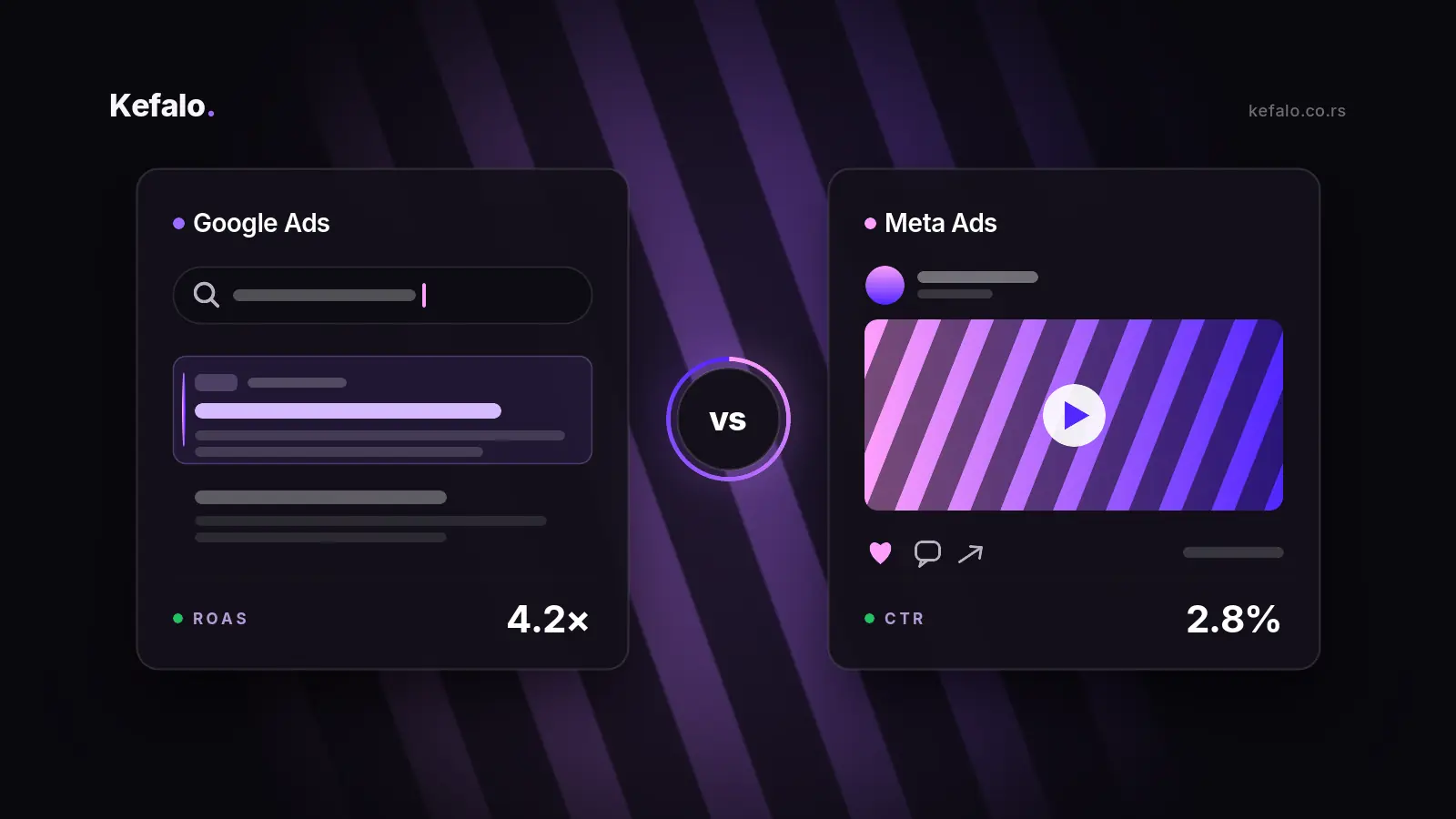
"Should we advertise on Google or on Facebook and Instagram?" It is one of the first questions almost every client asks us, and the honest answer is: it depends on what you sell, who buys it and how they make the decision. Both platforms can bring excellent results. Both can also burn through a budget surprisingly quickly if they are used for the wrong job.
In this article we explain the real difference between Google Ads and Meta Ads, when each one makes more sense, how they charge you, how to measure results properly and why the best campaigns often use both.
The key difference: intent versus attention
The simplest way to understand the two platforms is to look at what the user is doing at the moment they see your ad.
On Google, people are actively searching. Someone typing "emergency plumber Novi Sad" or "web design agency for real estate" already has a need and is looking for a solution right now. Google Ads lets you appear exactly at that moment. In marketing terms, this is capturing existing demand.
On Facebook and Instagram, people are not looking for you. They are scrolling, watching stories and catching up with friends. Meta Ads lets you interrupt that scroll with something interesting enough to stop it. That is creating demand: showing your product to people who match your ideal customer before they even know they need it.
Neither approach is better. They are simply different tools, and the right choice depends on whether people are already searching for what you offer.
When Google Ads makes more sense
Google is usually the stronger first choice when:
- People already search for your service. Plumbers, dentists, lawyers, car services, accounting, B2B software. If there is search volume, there is demand you can capture.
- The need is urgent. Nobody scrolls Instagram hoping to find a locksmith. They search, call and decide within minutes.
- You are a local business. Search ads and Google Maps placements reach people nearby at the moment they are ready to visit or call.
- The purchase is considered and rational. B2B services, expensive equipment or professional services are often researched through search before anyone gets in touch.
The biggest strength of Google Ads is the quality of the traffic. Visitors arrive with a clear intention, which usually means higher conversion rates. The limitation is that you can only reach as many people as are already searching. If almost nobody searches for your product, Google cannot create that demand for you.
When Meta Ads makes more sense
Facebook and Instagram are usually the better fit when:
- Your product is visual. Fashion, food, interior design, real estate, travel and beauty sell through images and video, and that is exactly where Meta shines.
- You are launching something new. If people do not yet know your product exists, they cannot search for it. Meta lets you introduce it to the right audience.
- The purchase is emotional or impulsive. A good-looking product at the right price can be bought straight from the feed.
- You want to reach a very specific audience. Age, location, interests and behaviour, combined with lookalike audiences built from your existing customers.
- You want to bring visitors back. Retargeting people who visited your website or engaged with your profile is often one of the most profitable campaigns on Meta.
The strength of Meta is reach and creative freedom. The challenge is that people did not ask to see your ad, so the creative, meaning the image, video and first line of text, has to earn their attention within a second or two.
How the two platforms charge you
Both platforms work on an auction, but the logic is different. On Google search you typically pay per click, and the price depends on how many advertisers compete for the same keyword and how relevant your ad and landing page are. In competitive industries, a single click can be expensive, but the visitor is usually close to buying.
On Meta, costs are usually calculated per thousand impressions, even when you optimise for clicks or leads. Reaching people is often cheaper, but more of them are early in the decision process, so you need more touchpoints before they convert.
That is why comparing platforms only by cost per click is misleading. What matters is the cost per result: how much you pay for an enquiry, a booked call or a sale, and how much that customer is worth to your business.
One more practical point: both platforms rely on algorithms that need data to learn. Meta describes a "learning phase" that an ad set leaves after roughly 50 optimisation events in a week, and Google's automated bidding works best with a steady flow of conversions. Spreading a small budget across too many campaigns means none of them ever collects enough data to perform well.
Why the best results often come from using both
Real customer journeys rarely happen on a single platform. A typical path might look like this:
- Someone sees your video on Instagram and learns your brand exists.
- A week later, a retargeting ad reminds them of your offer.
- When they are ready, they search for your name or your service on Google and click your search ad.
- They fill in the form on your website.
In this scenario Meta created the demand and Google captured it. Looking at either platform in isolation, it would seem that one did all the work and the other did nothing. That is why we usually recommend starting with the channel that fits your business best and, once it is profitable, adding the other to cover the rest of the journey.
Measure what actually matters
Without proper tracking, advertising turns into guesswork. Before spending serious money, make sure you have:
- Conversion tracking on every important action: form submissions, phone calls, purchases, WhatsApp or Viber messages.
- Google Analytics 4 connected to Google Ads, so you can see what visitors do after the click.
- Meta Pixel together with the Conversions API, which sends events from your server and is far more reliable than the browser pixel alone.
- UTM parameters on every link, so each visit can be traced back to its campaign.
- A consent setup that respects privacy rules, which is especially important if you advertise to visitors from the EU.
Most importantly, connect advertising results to real business results. A campaign with cheap leads that never become clients is more expensive than one with fewer, better enquiries.
Common mistakes we see
- Sending all traffic to the homepage. Every campaign deserves a landing page that matches the ad and has one clear next step.
- A slow website. You pay for every click, including the ones from people who leave before the page loads. We wrote about this in detail in why website speed decides whether you get the client.
- No negative keywords on Google. Without them, you pay for searches like "free", "jobs" or "DIY" that will never become customers.
- Judging campaigns too early. Turning ads on and off every few days resets the learning process and makes results worse.
- Using the same creative for months. On Meta, audiences get tired of seeing the same ad. Fresh images and videos keep costs under control.
- Optimising for the wrong goal. If you optimise for clicks, the platform will bring you people who like to click, not people who like to buy.
A quick decision guide
- People actively search for what you offer → start with Google Ads.
- Your product is new, visual or impulse-driven → start with Meta Ads.
- You are a local service business → Google search and Maps first, Meta for awareness and retargeting.
- You sell a high-value product with a long decision process → combine both, with retargeting in the middle.
- Your budget is small → choose one platform and do it properly, instead of doing both badly.
How we approach campaigns at Kefalo
Because we build websites and run campaigns under the same roof, we look at the whole path, from the first ad impression to the form on the landing page. We start by understanding how your customers make decisions, set up tracking before launching anything, test several messages and creatives, and then shift the budget towards what brings real enquiries and sales. You can read more about our social media and advertising services.
The question is not "Google or Meta?", but "where are my customers, and what are they doing when they could meet my brand?"
Conclusion
Google Ads catches people who are already looking for you. Meta Ads helps people discover you before they start looking. Once you understand that difference, choosing a platform becomes a business decision rather than a guess, and combining them becomes a strategy rather than a split budget.
Not sure where your budget would work hardest? Get in touch and we will review your business, your website and your current campaigns, and suggest a clear plan for where to start.